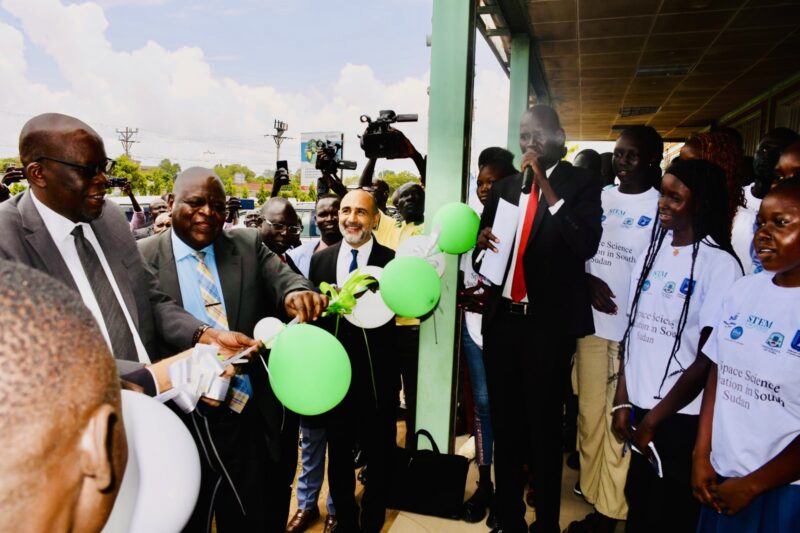
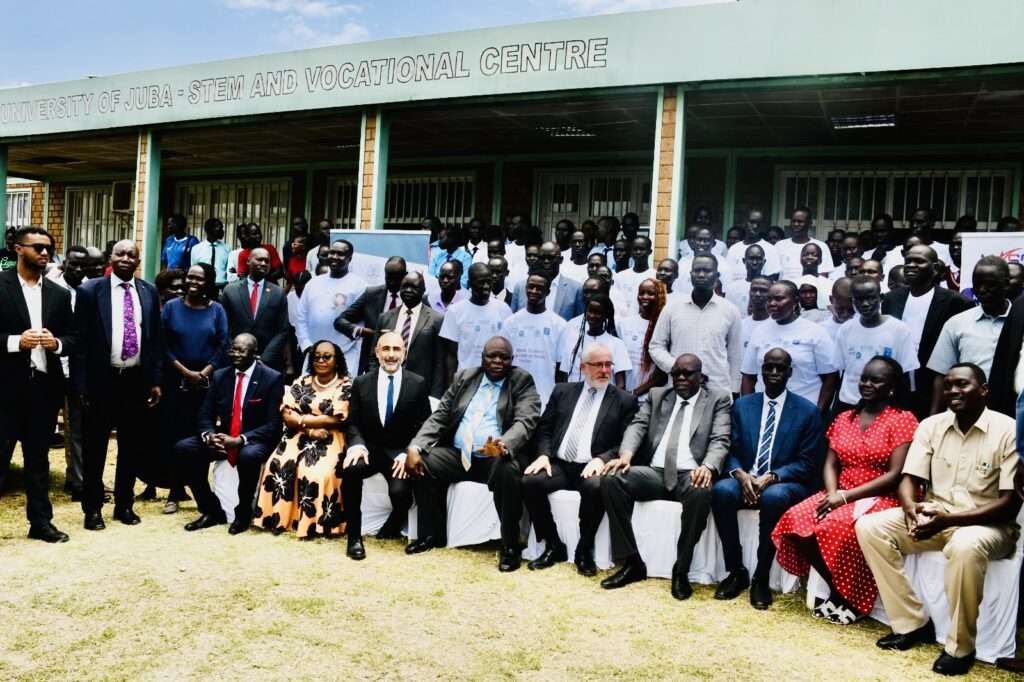
On September 10th, 2025, the University of Juba-Mayardit Academy for Space Science in partnership with Harel Space Science Agency, Embassy of Isael to South Sudan, and STEM Power, South Sudan launched the 1st Space Science Education Programme for School under the theme: “Empowering South Sudan’s Future Through Space Science and Technology.” In the University of Juba, STEM Centre.
Prof. John Apuruot Akec, the Project Director of Mayardit Academy for Space Science (MASS), presented the academy’s overview to the University of Juba Senate on December 2, 2022. Prof. Akec explained that MASS was established to honor South Sudan’s first President and is designed to respond to the increasing interest in space programs across Africa, where over 20 countries have active initiatives. Prof. Akec highlighted the role of space science in weather forecasting and disaster management, which contribute to sustainable development. He shared MASS’s objectives, including raising awareness and encouraging youth to pursue STEM (Science, Technology, Engineering, and Mathematics) education. Initial doubts about the program have been replaced with optimism due to ongoing seminars and exchanges. Prof. Akec acknowledged the support from the University of Juba and expressed pride in South Sudan’s involvement in space science.
Dr. Christopher Tombe Louis, the Dean of the School of Applied and Industrial Science and Chairman of MASS, discussed the organization’s mission to foster the scientific potential in every child. Dr. Louis mentioned his role in the East African Science and Technology Commission and his contributions to developing the Science and Technology Innovation Policy for 2023-2028. Dr. Louis noted that South Sudan’s potential in space science was recognized during regional discussions, which aligned with MASS’s objectives to promote space applications and services, develop human capital, increase public awareness, and encourage collaboration.
Sarah Moses, a STEM student representative, emphasized that pursuing science should not depend on gender but on interest and participation.
Harel Hary Ben-Ami, Managing Director of Harel Space Agency, stated that MASS is the first space sciences academy in South Sudan. This initiative, supported by the Israeli Ministry of Foreign Affairs, aims to enhance the country’s capabilities in space sciences. He recalled the first Space Sciences Seminar held at the University of Juba in 2024, highlighting aspirations to combine efforts to address social issues through space sciences.
Lucy Biel, Director of STEM Power South Sudan, expressed pride in the partnership with MASS and excitement about recent training for students and teachers, enhancing their curiosity in space science. She encouraged continuous engagement with space science content and outlined the goal of expanding STEM initiatives across the country with existing STEM centers.
Eng. Chol Joseph Mayen Dut, the Director General of Research and Planning in National Communications Authority (NCA), highlighted that NCA is providing extensive support across various dimensions, with a current focus on the educational sector. NCA is actively assisting the Academy in this area. Eng. Dut noted that NCA has established a new space department within the NCR (National Communications Regulatory Authority), to strengthen this department, staff have been sent abroad one team member completed training in Japan in satellite communication to support the department’s activities. Additionally, Eng. Dut mentioned that NCA is sponsoring students who aspire to study fields related to satellite technology and communications. Furthermore, Eng. Dut mentioned NCA has succeeded in securing two orbital slots for satellites, which will be used primarily for communication and broadcasting purposes. These initiatives reflect NCA’s commitment to advancing space and communication technology, as well as supporting education and innovation in these fields.
Amb. Wol Arich, from the Ministry of Foreign Affairs, spoke about the importance of freedom and happiness, referencing South Sudan’s resources and its potential for progress. He compared South Sudan’s emerging collaborations to historic achievements in exploration.
- E. Gershon Kedar, the Israeli Ambassador, reflected on his meetings with Prof. Akec and expressed support for South Sudan’s potential in space sciences, emphasizing cooperation at both academic and grassroots levels to nurture future scientists in the country.
Prof. Isaac Cleto Rial, the Acting Vice Chancellor of the University of Juba, mentioned key advancements in space sciences in Africa over the last five years, highlighting the establishment of more than 20 space agencies. Prof. Rial noted that over the past 30 years, more than ten African countries have launched satellites, demonstrating significant progress in space capabilities. Prof. Rial mentioned specific countries with active space programs. Prof. Rial emphasized on University of Juba Strategic Goals (5&6) aimed at integrating national economies into a global knowledge-based system and facilitating technology transfer. Prof. Rial thanked various organizations for their support in improving space science education.
Hon. Dr. Kuyok Abol Kuyok, the Minister of General Education and Instruction, Acting Minister of Higher Education, Science and Technology, and the Guest of Honor of the event, highlighted that the President reaffirmed the government’s commitment to science education during the swearing-in ceremony of the new Minister of Higher Education, Science, and Technology. Hon. Kuyok emphasized that the President directed the Minister to introduce innovative approaches to revitalize quality education across South Sudan. Hon. Kuyok remarked that this Programme would significantly contribute to equipping learners, especially in science subjects taught in schools, as it aims to inspire future scientists. Hon. Kuyok underscored that the inauguration of the Space Sciences Programme into the national science curriculum reflects the nation’s educational strategy to equip students with the necessary tools, knowledge, and inspiration to succeed in the 21st century. Furthermore, Hon. Kuyok stressed that both the Ministry of General Education and Instructions and the Ministry of Higher Education, Science, and Technology are committed to incorporating space science education into their national curricula and university programs, fostering a culture of innovation and scientific advancement in South Sudan.
The launch of the Space Science Education Programme marks a significant milestone for South Sudan, positioning the nation to harness the potential of space science and technology for sustainable development and innovation. By integrating space science into the national curriculum, this initiative not only empowers the youth but also fosters a culture of scientific inquiry that is essential for the country’s future progress.